Saturday, September 7, 2019

Approaching Our Third Anniversary


A month, in the grand scheme of time, is not much time.

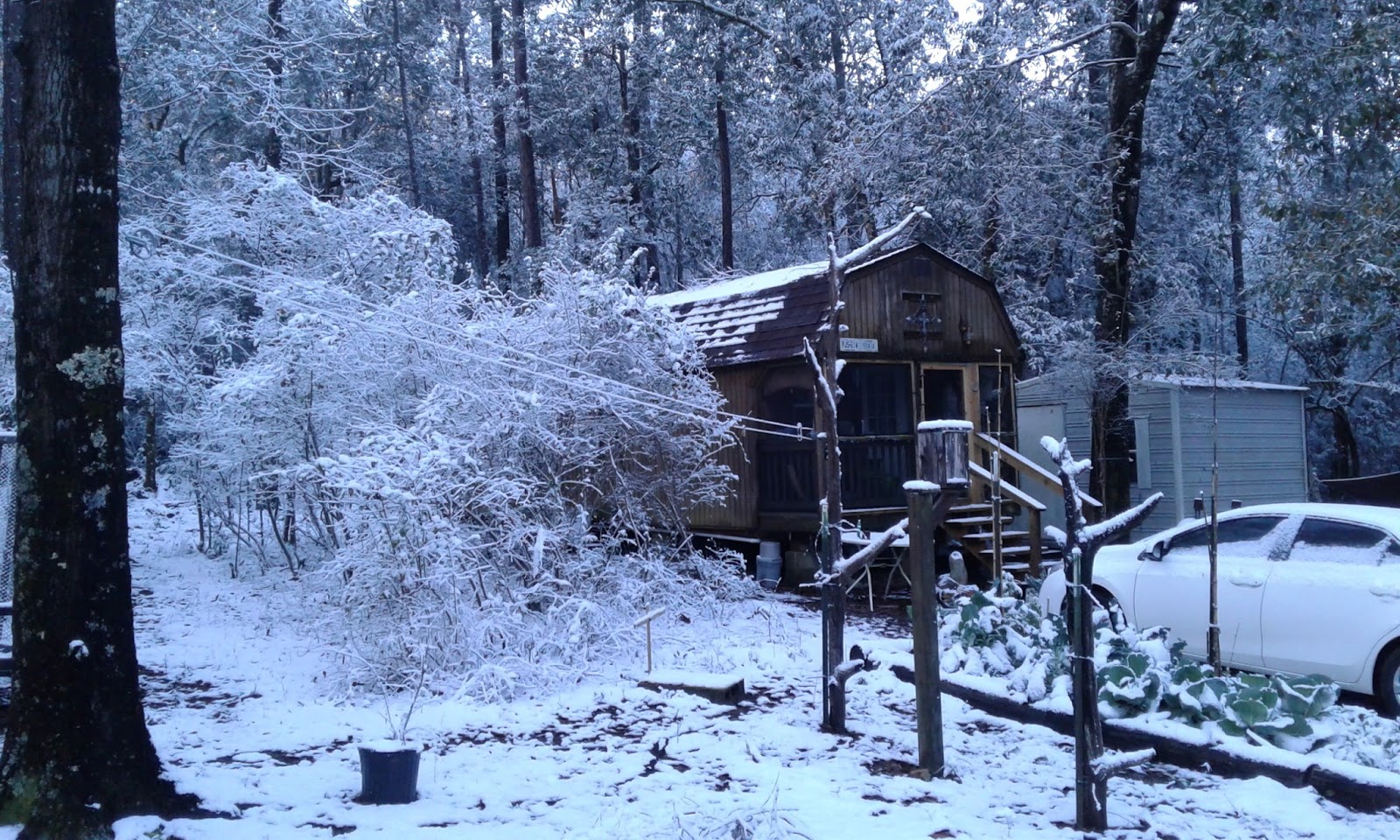
It is, with the grand scheme of time in mind, that I undertake to keystroke a few comments about our life here at our little cabin in the woods a month in advance of the October date [October 21st] that will mark our Third Anniversary of doing what we refer to as the small space shuffle.

I want to particularly answer three questions that are pertinent to life in the here and now for us.


Q. Are we still content doing the small space shuffle?


We are.

We are absolutely content doing the small space shuffle after three years of doing it. We are sure this surprises the naysayers and those that thought we were crazy back at the beginning of this journey.

Do not think for a minute that it is not still challenging. There were a few emotional challenges at the outset. We had to learn how to let go of stuff. It is crazy just how emotionally attached we get to our stuff. Not now though. The challenges are more of the physical type. What is the greatest physical challenge that we face at this point three years into the adventure? The greatest challenge is finishing several unfinished projects. Especially the unfinished projects inside the cabin.

There are, I think, a couple of reasons for this.

The first is that we are not in some kind of keeping up with the neighbor’s contest where things are concerned. We live simply. And we simply live in the woods.

The other is that things like finishing the counter in the kitchen corner and redoing the floor are not as easily done as thought about. It is not like there is a spare room or corner to set things up that we use every day as part of normal life.

Strictly to the question … we are perfectly content and cannot fathom the idea of returning to the status quo of normal home ownership, mortgage payments, high utilities, or all the expectations, glitter, and glamor that goes along with what we called life in the ruburbs. [Ruburbs is that geographic area that is no longer rural but not quite suburban. It is the area at the edge of the sprawl characterized by large houses and acreages.]

It helps, too, that Shirli and I have both recognized and embraced our hermit dispositions.

Q. What have we been up to over the course of the past year?

Quite a lot, and at the same time, not much at all.

It takes some time to settle into this thing called retirement.

We have managed to settle. We have managed to let go of feeling like we have to be constantly producing in order to be productive humans … that mindset that gets engrained in us … that mindset that keeps our noses to the grindstone … that mindset that deceives us into thinking that we are less than others if we do not have what they have as signs of success … that mindset that tricks us into thinking that we need more than we honestly need in order to be happy and content on the topside of the sod.

We have mostly been simply living. We have mostly been simply taking care of ourselves.

A large part of simply taking care of ourselves involves our faith-life; an area that is easy to neglect when hammering out a living. We were, when an alarm clock and a time clock owned us, snatching and grabbing at a little devotional time here and there to maintain some semblance of the larger devotional picture. 

It is that way with all of us. Now that we are retired, and settled into it, we are able to do better than snatch and grab. The challenge now is not the time clock and the demands of the workaday life. The challenge is in the personal discipline department within ourselves … a dimension that presents itself as a far greater challenge now than before now that there is time to reckon with it.

We now own that alarm clock. It rarely gets set. Sleeping in [a lot of days it has been daylight for an hour when we awake] no longer launches us into high gear so we can get out the door.

Something more tangible though, in answering the question, has to do with a magazine. Shirli and I have three articles in the works at Backwoodsman. When will they be printed? That is a question that we cannot answer. We are looking forward to their publication though. Not so much to garner any personal attention but more so to encourage others – particularly where tiny house living and container gardening in small spaces are concerned.

Q. What plans do we have for the coming year?

The short answer is … JUST LIVE and ENJOY LIFE!

The longer answer is a bit more wordy. The longer answer is more elusive. The longer answer involves one of those it depends clarifiers.

The it depends thing is the real kicker right now. How we are going to go about just living and enjoying life is going to be partly determined on the 16th of this month. That is the date for Shirli’s follow-up with the team that did her surgery after a polyp tested positive for endometrial cancer. The follow-up is when we will find out the results of the pathology.

Everyone every step of the way has been very helpful, hopeful, and encouraging. The eyes of the surgeons saw nothing that caused them to be alarmed when they performed the hysterectomy. We are expecting to hear good news from the doctors on the 16th – that the cancer was only in the one polyp and that no other treatments are needed or recommended.

So, in going forward, we are simply going to keep practicing what we preach. We are going to keep believing and trusting God, knowing that life on this planet is only the journey and not the destination. We are going to be ever more mindful about taking the time to do the things that are important to us. And, in the midst of the going and doing, we will be evermore mindful of the love ideal that is so badly deficient in the void created by the social fabric of this sad post-modern culture.

The love ideal?

Jesus said, I give you a new commandment, that you love one another. Just as I have loved you, you also should love one another. By this everyone will know that you are my disciples, if you have love for one another. [John 13:34-35]

It is easy to say. The doing of it grows easier the more we practice it. 

We learn, in the doing of it, when and to whom it is necessary to love with a tough love that limits [perhaps prohibits would be a better word in some cases] their personal dysfunction and drama from destroying our peace. Tough love is the most painful kind of love. It is important to remember that monastery walls are not built to keep the monks inside the monastery. They are built to protect the peace and serenity of the monks by keeping the world, its worldlings, and even large numbers of professors of faith outside the monastery where they can do no harm to those inside. The enclosures represented by our personal lives must necessarily include protective barriers.

Regardless ... JUST LIVE.

Regardless ... ENJOY LIFE.

Regardless ... MAKE THE MOST OF LIFE AND CHERISH EVERY MOMENT THAT WE HAVE.

Regardless of what is going on in the surrounding world or in the smaller world comprised of our own small life-circles … never let go of faith, hope, and love.

There is more to come.

Peace to you and yours,

David & Shirli

Monday, January 15, 2018

Living Life Up In These Woods

The process involved in getting from where we were … there …  to where we are now … here … was not at all simple.

The real deal was quite complicated.

A lot had to be dealt with to get the ball rolling. A lot more had to be dealt with once the ball started rolling. A huge lot more had to be dealt with to keep the ball rolling. At times the ball rolled pretty well on its own. At times we had to apply our shoulders to it to keep it rolling uphill.

An awful lot of physical motion was involved in getting from there to here. There was a complicating factor stirred into the physical pot. That physical motion had a lot of emotional motion inherent within it.

Change, even change for the better, is rarely easy.

Change … real, lasting, and meaningful change, rarely happens overnight.

Change has a price tag attached to it.

Getting from there to this exact geographical here, was something that involved a 5-Year plan.

This exact geographical here?

This exact geographical here was not part of our initial plan. Our initial plan involved a fairly remote and out of the way piece of land that we owned on the Cumberland Plateau in Tennessee. The only significant logistical alteration to our plan was the exact geographical here.

Looking back over the process, this logistical alteration turned out to be a really sweet deal.

So, what’s happening in the now at our exact geographical here fifteen months into our small cabin life in these woods?

The answer to the question involves two levels.

The first, and most obvious to onlookers, is the surface level.

There is a honey-do list on the front of the fridge. Important stuff to get done while getting other important stuff done. Every fridge door needs one. It is totally Un-American to not have a honey-do list attached to the fridge by a fridge magnet.

It took a little doing back in the fall to get the sawmill up and running. The mill sat idle for years down there. My son-in-law helped with the necessary tinkering involved in getting the mill sawing wood again here.

The first milling project was to turn some nice Red Oak into boards that were stacked out of the weather to season. The milled oak boards will be turned into rustic furniture for another project.

The other project?

Shirli is in need of what we are calling Shirli’s She-Shed Woman Cave.

The space available here in the small cabin is fairly well utilized to the max for what has become our normal indoor mode of living. We are still making adjustments, slight rearrangements, and coming up with ways to best utilize the small square footage contained within the walls of a small structure. 

There’s simply not space to set up a sewing machine for sewing projects, or a quilting frame (something else that I will build), or for Shirli to work on other crafty stuff that requires space and time. The majority of her tinkering goodies are stored in totes in the cabin lofts.

I am using the mill to convert pine logs into the needed framing material for the project. Fun stuff. Fun stuff that involves a lot of old school heavy material handling tactics. Fun stuff that, at this stage of age, causes me to reach for that bottle of Ibuprofen in the evening. There is a serious personal sense of accomplishment found in safely manually moving a 400-pound log from where it is laying in the woods to the mill and turning it into usable building material.

The stuff on the obvious surface is important stuff.

More importantly, for us anyway, is what is happening beneath the observable surface.

It’s down there. Inside.

Shirli tossed in the towel six months ago. Simply said, “Enough. I quit.” (Bravo and a big round of applause!)
She had not quite arrived at the Golden Age of Demarcation that qualified her to receive what has been referred to as Post Office Money. You know. That check sent out monthly by the Social Security Administration. Times have changed. It’s now Direct Deposit.

I “officially” retired two years ago come March but came “out of retirement” after we moved to the cabin so Shirli wouldn’t have to make the long daily employment commute by herself. I returned to my official retirement when Shirli tossed in the towel and called it quits.

We were both wiped out. Exhausted. Used up.

All the physical and emotional motion and commotion involved in getting from there to here had drained our batteries pretty low. Making the 100+ miles a day commute for the length of time that we did finished draining our batteries to the point that they would barely light up our dome lights.

It’s taken time to recover from the drainage.

It’s not something that we intentionally set out to do. It’s not something that we were conscious of or consciously pursuing. It’s not one of the items on the honey-do list.

It’s something that we have experienced as part of our settling into this retirement gig up in the woods.

We are coming back. We are beginning to feel like ourselves again. Small pools of creativity are puddling and there is time now to entertain and stir those puddles. The kid in us is to beginning joke, laugh, kick off their shoes, and stomp in mud puddles. Dang, but it does feel good!

We are rediscovering our cranking amps. We are, in fact, just now honestly beginning to realize the effects of the long and slow six-month trickle charge we’ve been on.


Life is indeed good up in these woods!

Friday, November 24, 2017

DIY Oak Lumber

It’s a good small mill.


We bought it about a dozen years ago.

I spent a generous amount of time researching all the sawmill offerings. There are some nice machines to be had … from Plain Jane models to models with all the bells and whistles. Small mills. Big mills. Automated mills. Manual mills. Mills that cost a few thousand dollars. Mills that cost a lot of thousands of dollars. Mills for the backyard hobby sawyer. Mills for the professional full-time sawyer.

The Hud-Son Oscar 18 seemed to be the most realistic offering that would set me up as a backyard hobby sawyer. This particular mill is powered by a 6.5 HP Briggs and, once a log has been squared, allows 18 inches between the blade guides. I’ve yet to cut anything 18 inches wide but I have milled some 14’s from pine with the mill.

The mill sat for several years down at the other place without being used. It took a little productive tinkering and piddling to get it going after moving it here to the hill.

The actual operation of the small manual mill is pretty simple.

The mechanics of the thing aren’t at all complicated. The biggest thing about it is to not hit anything with the blade other than wood … things like the log dogs that hold the material in place. I ruined a blade by that mistake. Nails hidden in a log are a mean culprit too. The only way I know of to avoid a hidden nail is to use a metal detector on a log if it came from an area where someone may have nailed something onto the tree.

The real learning curve involves material handling.

Logs are heavy. An 8-foot Southern Red Oak log that has a diameter of 20 inches weighs right at a thousand pounds (991). Longleaf Pine, of the same dimensions, weighs just over half a ton (1030). It seems strange that this type of pine is heavier than the oak but those are the estimated weights generated by the log weight calculator.

Safely handling that sort of weight, without the assistance of wheels and hydraulics, isn’t terribly complicated. It does involve returning to and applying some ancient Old School science. Personally, applying and realizing the effective results of this old school science is quite gratifying. Ropes, ramps, levers, and fulcrums. It’s amazing what these four will do for us.

The first main thing to remember is to keep body parts, especially fingers and toes, out of pinch points.

The second main thing is to always think ahead and take steps to control the roll of a log in the event the sum of movement + gravity + weight creates a potentially dangerous situation.

There was some tree work that needed doing here on the hill. Two trees needed taking down. My son in law and I studied on these two trees for a long time and decided that these were trees that posed the potential to get the best of us despite our best efforts. Both trees were potential future problems and taking them down required the assistance of an experienced tree man with the necessary gear to climb and top them out before laying the logs on the ground.


The tops were turned into firewood. The logs made their way to the mill where they were milled into some nice material for some rustic furniture projects.

Sunday, October 22, 2017

Our Own One Year After

Yesterday, October 21st, was our One Year Anniversary.

We have been living in this little cabin in the woods … something that we call our camping cabin on steroids … for a year.

I think, if we had to choose one word to describe where we are in our acclimation to small cabin life, it would be … FREEDOM!

Long we have sought it. Every small enticing taste of it, every faint whiff of its fragrant aroma, spurred us on in our quest for greater personal levels of it.

It cost us quite a lot to get to where we are.

Not so much in the financial department. Everything costs. There is no getting around the reality of this issue. It did take some dollars to get settled into this lifestyle mode. Not too many dollars though and we were able to get to this point without incurring MORE DEBT!!! Incurring more debt would have only served to keep us bound to the endless going nowhere motion of the hamster wheel.

The best thing to do with debt is to get out of it by whatever means is necessary and, once out of it, STAY OUT OF IT!

Pay it off and get out from under it. Sell it off and get out from under it. Throw in the towel. Declare bankruptcy and get out from under it. Do what you’ve got to do to get out from under it and start over fresh.

Make your plan. Work your plan. Stay focused on your plan. A lot of seemingly impossible plans can become reality over the course of 5 years.

It cost us, more so, in the what people think department.

It’s kind of a bizarre thing. You’d think that long-time friends and acquaintances would be encouraging and cheer you on. Forget that notion. Pitifully few of them will give you a thumb up in support. Most of them will, in fact, do what they can to dissuade you. And, when not dissuaded by their well-intentioned negativity, most of these well-intentioned friends and acquaintances will treat you as if you’ve contracted leprosy.

There are social and psychological reasons for their dissuasion and response to our staunch stand. I think … and this “I think” is based on my own college centered studies in sociology and psychology coupled with a generous number of years of behavioral observation … those doing the dissuading are not so much concerned about your welfare and happiness … they are experiencing forms of abandonment, rejection, and sometimes jealousy.

They simply can’t handle the fact that they are being left behind. 

Rather than face their own interior inadequacies, they cloak their inadequacies in garments of pseudo-altruism. Those that cloak their interior inadequacies in garments of religious pseudo-altruism are the worst of the lot.

Freedom.

Now that’s an interesting word.

It’s a difficult word to wrap our minds around. 

Especially in our modern culture where our freedom to choose, more often than not, harnesses us more tightly to the wagon that is set upon by the lenders, purveyors, and the politics of modern social planners. According to the standards set by the aforementioned, our personal success is then measured by what we accumulate, how much we accumulate, the size and brand of what we accumulate, and the amount of debt we can carry without going bankrupt.

Our chosen lifestyle suites us quite well, looks good on us, and we consider that we have discovered a lifestyle of living large!  We now have time to focus on and do the things that are important to us in life. 

Doing the difficult work to get to this small space that affords us generous volumes of freedom … 

this place where we have walked away from the stress and strain of mortgaged life … 

this place where we have ceased feeling obligated to keep plugging along at jobs until we are too old to enjoy a retirement life … 

has been well worth the effort.


Thursday, October 5, 2017

Super Tea

Shirli and I really enjoy what we call our Super Tea.

3/5ths of the ingredients in our tea are harvested either outside the door of the cabin or on a short walk from the cabin. 

The hibiscus and peppermint are purchased.

Any one of the five ingredients will stand alone as a pleasant beverage. Any one of the five has important health benefits.

Combined in a tea, what we have is a powerful blend of healthy and tasty goodness that works as both a preventative and a curative. We like to add a little honey to ours. Any honey will do for a little sweetness. For the best health benefits, honey robbed from hives situated close to home (wherever home is for whomever) is best.

Let’s look at what the ingredients provide when steeped into a tea. Here's what we've discovered in researching these ingredients.


Blueberry / Huckleberry Leaves

+ The leaves of these berry bushes contain 31 times the antioxidants as the berries.
+ They are a great source of Vitamin C.
+ Improves memory and helps prevent cognitive decline associated with aging.
+ Fights inflammation and helps prevent cardiovascular disease, cancers, and strokes.
+ Lowers triglycerides.
+ Lowers blood pressure.
+ Helps heal and prevent eczema, psoriasis, and other inflammatory skin diseases.
+ So high in antioxidants that it can prevent and possibly heal Type-2 Diabetes.
+ Lowers blood sugar up to 27%.
+ Studies show that properties in the leaves may prevent and heal Hepatitis C by preventing replication of the virus.
+ Helps prevent Macular Degeneration.
+ Helps prevent and heal Chronic Fatigue Syndrome.
+ Has shown to have a healing effect on Multiple Sclerosis.
+ Helps prevent and repair DNA damage caused by free radicals.
+ Strengthens veins, arteries, and capillaries.
+ Helps the female reproductive system. Helps to heal fibroids. Helps with cramps. Helps with P.M.S.. Tones the uterus and fallopian tubes.

Goldenrod

+ Tightens and tones the urinary system and bladder and helps with Urinary Tract Infections.
+ Restores balance to the kidneys.
+ Flowers and leaves can be infused in oil and used to tread burns and wounds.
+ Provides an antidote for seasonal ragweed allergies.
+ Has antiseptic and antimicrobial properties to treat sore throats.
+ Acts as an expectorant.
+ Opens the pores of the skin to release sweat during fevers.
+ Contains Rutin … a powerful flavonoid that benefits the cardiovascular system.
+ Contains antifungal saponins and is a useful alternative for treating Candida type yeast infections.

Pine Needles

+ Rich in antioxidants, Vitamin A, Vitamin C, and flavonoids that protect cells from damage by free radicals.
+ Helps prevent chronic diseases such as heart disease, diabetes, and Alzheimer’s.
+ Contains anti-inflammatory properties that help prevent the oxidation of low-density lipoprotein … the bad cholesterol.
+ Contains Shikimic Acid … the main ingredient in Tamiflu.

Hibiscus

+ Lowers blood pressure.
+ Has diuretic properties.
+ Helps lower bad cholesterol.
+ Helps heal liver disease.
+ Contains Hibiscus Protocatechuic Acid which has anti-tumor properties that slow down the growth of cancer cells by inducing programmed cell death.
+ Has properties that calm the nervous system, reduces anxiety and depression.
+ Contains anti-inflammatory and antibacterial properties that prevent catching colds and flu.
+ Relieves menstrual cramps and pain. Restores hormonal balance to reduce mood swings and depression.
+ Improves digestion.

Peppermint

+ Soothes upset stomach.
+ Aroma boosts mental performance.
+ Helps loosen congestion and relieve coughing.
+ Relieves halitosis.

That’s a lot of good stuff in a handful of ingredients steeped into a tea.

There are only two cautions that I know of where these ingredients are concerned.

They have to do with the pine needles.

Some sources insist that pregnant women should stay away from pine needles. One of the pines, the Ponderosa, is suspected to cause abortions in cattle that graze on the needles. Nothing is said about how long they grazed or the quantity of needles eaten.

The other caution concerns the Norfolk Pine.

The Norfolk Pine (something that is more of an ornamental than a tree growing in the woods) is toxic.

Where topics such as this are concerned, it's always in the best interests of people to do their own research, arrive at their own conclusions, and make their decisions based upon what they have discovered and concluded. That's the way we go about it and that is what we are comfortable with.

Also, when harvesting from nature, make certain that you can positively identify what you are harvesting. Mistakes on your part are your responsibility.


Thursday, August 10, 2017

Open-Fire Canning


Some things bring back memories and I couldn’t help but to think about that cool damp hole beneath the pumphouse while I sat outside under the fly peeling pears.

My brothers dug that hole. Hand dug. A couple of boys with shovels in their hands.

I never measured the dimensions of that hand dug cellar. Looking back, thinking back and guesstimating, it was around 10’ by 12’ and deep enough that a 6’ person could stand without bumping their head on the rough-cut pine floor joists overhead. The cellar stayed close to the same cool temperature year ‘round and made an ideal place to store all those shelves of jars filled with canned vegetables, jams, and jellies. Potatoes kept fairly well but someone had to regularly pick through them to get rid of the rots. That someone was me once I was grown enough to carry a bucket up and down the cellar steps.

We were, unbeknown to our family those 60 plus years ago on my personal life-calendar, what modern folks now call preppers. 

It was a way of life for us … prepping for the coming years, living daily out of our stores, and annually rotating and replenishing our stock. Our family was good at it too. My mom and dad knew what we needed to go another year. We always put up at least what we needed and there was always some reserve left over when the new stuff made its way to the shelves.

I don’t know who came up with the idea or when the practice first started. I suppose I could Google the history of canning and find out. I do know that, by the time I came along, my folks knew all about it and depended upon it as a way of life.  It was our means of storing food for personal use out of season when it doesn’t grow. Canning vegetables and fruit outdoors over an open fire was knowledge and skills that my mom learned from her parents and my dad learned from his.

I am, where my lineage is concerned, at least a 3rd Generation practitioner of these skills.

One significant difference between water-bath canning and pressure canning is the length of time that it takes to do the cooking part of the process. All the other parts of the process are the same. The reason pressure canning time is so much less is that the amount of heat inside the container is increased by pressure. Water boils at 212 degrees. Add 10 pounds of pressure and that same 212 degrees becomes somewhere between 240 and 260 degrees … more than enough heat to cook the food and destroy anything that might make you sick (or worse).

There’s a big difference between a 35-minute cook time in a pressure canner and a 3.5-hour cook time in a water-bath container. Where a pressure canner uses the increased temperature caused by pressure to safely process (can) vegetables and fruit, the water-bath canner uses what seems to be an extreme amount of time at boiling temperature to safely accomplish the same task.

We kept the canner at a rolling boil for 3.5 hours regardless of what we were canning … not 3.5 hours from the time we started the fire under the canner. (Let me mention that we DID NOT can meat or fish.)

Another significant difference is that a water-bath canner can be made out of any suitable sized container that will hold canning jars. Our family wore out several 55-gallon oil drums. We always kept one in reserve knowing that the one in use would eventually rust out. We used only oil drums. We’d cut the top out of a drum. Then we’d build a good hot fire in it to burn out the oil. Once the oil was burned out, we’d give the drum several good washings with Tide detergent before giving it a good final rinse.

DO NOT use drums or containers that held chemicals or toxic substances.

Yet another significant difference that I can think of is that you simply do not set a pressure canner on a grate over an open fire. Pressure canners are sensitive pressurized bombs. You must be able to carefully regulate the temperature beneath them to keep the pressure where it is supposed to be. You must constantly keep an eye on the pressure gauge. The worst that can happen to a water-bath canner over an open fire is a boil-over caused by too big a fire. That same too big a fire might cause a sensitive pressure canner to blow its gasket and cause some serious bodily injury.

Some folks set their canning drums on concrete blocks. We didn’t. We set ours on disc spacers that had been salvaged from an old disc harrow. A couple of firings and concrete blocks tend to crack and fall apart. That could be disastrous with a drum full of filled quart jars cooking away. The cast spacers refused to give up the ghost when the going got hot.

This business of open-fire canning is something that prepper-folks should give some serious consideration. It has a definite off-grid application. It has a definite grid-down application. There are numerous skills involved in the process … skills that need to be honed long before a real catastrophe hits. The necessary tools to accomplish the task aren’t difficult to come by.

We are coming up on our Ten-Month Anniversary as full time small cabin dwellers. We’ve settled into the small cabin in the woods lifestyle and can’t imagine ever returning to living in the midst of all the hustle, bustle, mayhem, and mania associated with life down there at the other end of the county. These woods suit us just fine. 

Running the road back and forth four days a week finishing up at the other end of the county is behind us now.

It’s a done deal. Shirli and I are now both officially retired.


Tuesday, July 18, 2017

Beginning A New Chapter


We’ve not published any updates on our doings here on the blog in a couple of months.

For those of you that have been following our small cabin in the woods adventure, pardon our absence from this side street in the electronic world.

The dynamics of the past couple of months have been quite intense. All our personal energies have necessarily been focused on finally arriving at the point where we are no longer making that long commute to the other end of the county. Finishing up has been a grind on us. That daily one hundred plus miles a day commute has been a grind on us.

We were about ground down by the grind.

We did it though!

We finally arrived at that hard fought for point in time!

It got to be some really hard going toward the end but we made it to the monumental leap!

It took nine months of finishing up down there. We moved into the cabin and became full-time small cabin dwellers on October 20, 2016. Down there, nine months … almost to the day … later, is now a finished chapter in our personal history.

Shirli and I are both officially retired.

The reality of this grand event has only just begun to settle upon us.

We are liking it. We are liking it a lot.

The thrust behind doing what we have done was to create a lifestyle that was simple and sustainable … a lifestyle devoid of the stress and mania associated with modern life lived on the hamster wheel where the runners are constantly running but getting nowhere in a hurry … a lifestyle that allows us to simply live and enjoy life at our leisurely pace … a lifestyle that allows us to do things that are important to us.

And here is the kicker in the deal … to do it all within the financial boundaries that most common working people have to work with and then live our retirement years comfortably on our small retirement income.

We have succeeded in doing what we set out to do!

What now?


We have a few cabin projects to take care of now that there is time to work on them. They will get done. It’s hard to imagine starting on any of them until we have taken a few days to unwind and decompress from the last part of that hard-uphill climb.

And now to chronicle a new chapter.